
 Connor had a dilemma on his hands. He took on a side job, helping someone with a building project. It wasn’t his normal line of work; he normally worked in a small company in shipping and receiving. But his dad was a building contractor and Connor had grown up in the business so he knew a thing or two about construction; and it wasn’t unusual for him to take on a few small side jobs; a little trim work here or there, perhaps. But this job was bigger, much bigger.
He wouldn’t have taken the job at all, but it was for a friend’s parents and it was originally going to be just a small addition. But one thing led to another and it turned into a much larger project. Nothing Connor couldn’t handle, though, and even working only evenings and weekends he managed to complete the work quickly enough to earn a bonus on top of his original quote. And just like that, Connor suddenly had a lot of cash in his bank account.
But when tax time came, Connor didn’t feel he should have to pay taxes on the money he earned from his side project. He had worked for cash, after all. And he had given up his nights and weekends for more than three straight months. Talking it over with Peter, his friend and coworker, Connor put it this way, “It’s my money. I earned it. I deserve to keep it. Besides, I spent most of it on that new truck of mine and the rest I put down on my house.”
“But it’s the government, Connor, they have ways of knowing these things,” Peter pointed out
“They sure do,” chimed in Sally, who couldn’t help but overhear the conversation.
And, indeed, the government did know about the extra money he had earned. They knew in two ways; the couple he had done the work for filed forms claiming tax deductions for the energy savings they would realize from the project; listing Connor as the contractor, of course. And financial records indicated that Connor could not afford his fifty-thousand-dollar new truck on his meager income as a shipping and receiving clerk.
So while Connor firmly and sincerely believed he should not have to pay taxes on this side project, the law said he did and the government soon sent him a letter stating just how much tax they calculated he owed, plus a small fine for paying late. But Connor ignored the letter, being so firm in his belief that he did not owe them a thing.
He eventually received another piece of correspondence from the government, this one a bit more emphatic than the last. The fine was bigger this time, too, raising the total he owed to a truly eye-opening amount. And again, despite the warnings of his coworkers and friends, Connor ignored the letter, sure that he did not owe them a thing. And then something happened that Connor could not ignore. He went to buy groceries after work and his card was rejected. And when he went out to his shiny new truck, it was being hauled away on a flatbed.
Having called Peter for a ride, he arrived at home and found the notice on his door. The government had seized his home and all its contents. And as he sat down on the stoop in utter shock, the federal officers arrived with a warrant for his arrest. At least the jail would be someplace warm to spend the night. Turns out, tax evasion is a pretty serious offense, and though Connor didn’t believe it, he was now in the throes of some rather harsh consequences.
And so we see, despite Connor’s firmly held belief to the contrary, he was guilty of tax evasion and there was a penalty to be paid. In his case it was a severe one, and his disbelief didn’t in anyway change that reality. And so it is when it comes to Jesus, what we believe or don’t believe doesn’t change reality at all. Many people choose disbelief, ignoring the historical reality depicted in the Bible and rejecting the redemptive work of Jesus Christ. This isn’t all that surprising, actually, for Jesus said, “Wide is the gate and broad is the road that leads to destruction, and many enter through it. But small is the gate and narrow the road that leads to life, and only a few find it.” (Matthew 7:13-14)
But the reality is that you will acknowledge Jesus is Lord, whether you choose to do it now, willingly, or later, posthumously. For God has told us that He “gave him the name that is above every name, that at the name of Jesus every knee should bow, in heaven and on earth and under the earth, and every tongue acknowledge that Jesus Christ is Lord, to the glory of God the Father.” (Philippians 2:9-11)
We all inherently know we are not perfect, that we have done wrong. Our conscious convicts us of that fact, whether we will admit it to others or not. We are being disingenuous if we deny this. And there is a penalty to be paid for our wrongs, whether we want to admit it or not. But if we walk through the small gate and accept the redemptive work of Jesus, our penalty is paid in full. Are you ready to take the narrow road?
We’d love to hear from you. Please leave a comment or drop us an email at: ReignDropsBlog@gmail.com
To stay current on Reign Drops, like us on Facebook: https://www.facebook.com/ReignDropsBlog/
Or follow us on Twitter: @ReignDropsBlog
<ahref=”http://www.blogarama.com/Religion-Blogs/376239-Blog” title=”Blogarama.com – Follow me on Blogarama”>Follow me on Blogarama</a>
 Labor Day is a national tribute to the contributions American workers have made to the strength and well-being of our country. The origins of Labor Day can be traced back to a celebration first held in New York City in 1882. There is a bit of debate over who actually first proposed the Labor Day holiday; some records show that Patrick McGuire, a cofounder of the American Federation of Labor, was the first to suggest the holiday, while others believe it was Michael McGuire who proposed the holiday while serving as secretary of the Central Labor Union in New York.
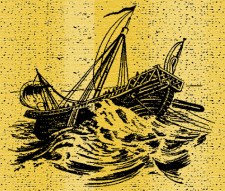 When the Apostle Paul sailed for Rome (see Acts 27) it was a perilous journey. In our day and age of luxury cruise ships and monstrous military vessels, it may be somewhat hard to imagine sailing on the types of ships used 2000 years ago, but my research tells me the ship Paul was on typically carried large payloads of grain and were of enormous size and had a crew of around 270 men. Still, by today’s standards it would seem quite primitive I’m sure.
 Most of us go to work on a regular basis; enduring traffic congested commutes, long hours, physically demanding tasks, bad bosses, gossiping coworkers, impossibly busy schedules, or any number of other sometimes frustrating situations so that we can support ourselves and our families. Some of us work in our chosen fields, for which we were specifically trained or educated, while others of us work at jobs that might not have been our first choice but for which we are now uniquely talented. Whatever your particular employment situation, each day you get up, go to work, and endure the routine all in the expectation of receiving fair pay for your efforts.
 It seems that we daily read of another terror attack somewhere in the world or some measure of strife between people groups. From the Orlando nightclub attack to the most recent attack in Nice, France and the growing unrest between the Black Lives Matter movement and police here in the US, there seems to be increasing tension around the world. For those personally affected by these attacks, our hearts ache for you; our prayers go out for all the victims, their families and friends, and all those whose lives are forever changed.
 In his second letter to the church in Thessalonica, Paul wrote: “Pray, too, that we will be rescued from wicked and evil people, for not everyone is a believer.” (2Thessalonians 3:2) So we see, even in Paul’s time, there was evil in the world, and Paul’s response was to ask for prayer, for he knew God is (as he notes in verse 3) “faithful; he will strengthen you and guard you from the evil one.” For Paul knew, as we should, that while it is people we see committing these atrocious acts of violence and fostering growing levels of animosity, the Bible reveals that underneath it all is a spiritual battle. And to win a spiritual battle we must fight on a spiritual level.
 Reign Drops